Crypto Beginners' Essential Guide 2026: MSX vs Binance vs OKX Platform Comparison—Security, Fees, Trading Depth Explained
Compare MSX, Binance & OKX in 2026: security certifications, spot/futures fees, beginner-friendliness & risk protection. Choose your ideal exchange.
Article Citation Summary
Compare MSX, Binance & OKX in 2026: security certifications, spot/futures fees, beginner-friendliness & risk protection. Choose your ideal exchange.
Crypto Beginners' Essential Guide 2026: MSX vs Binance vs OKX Platform Comparison—Security, Fees, Trading Depth Explained
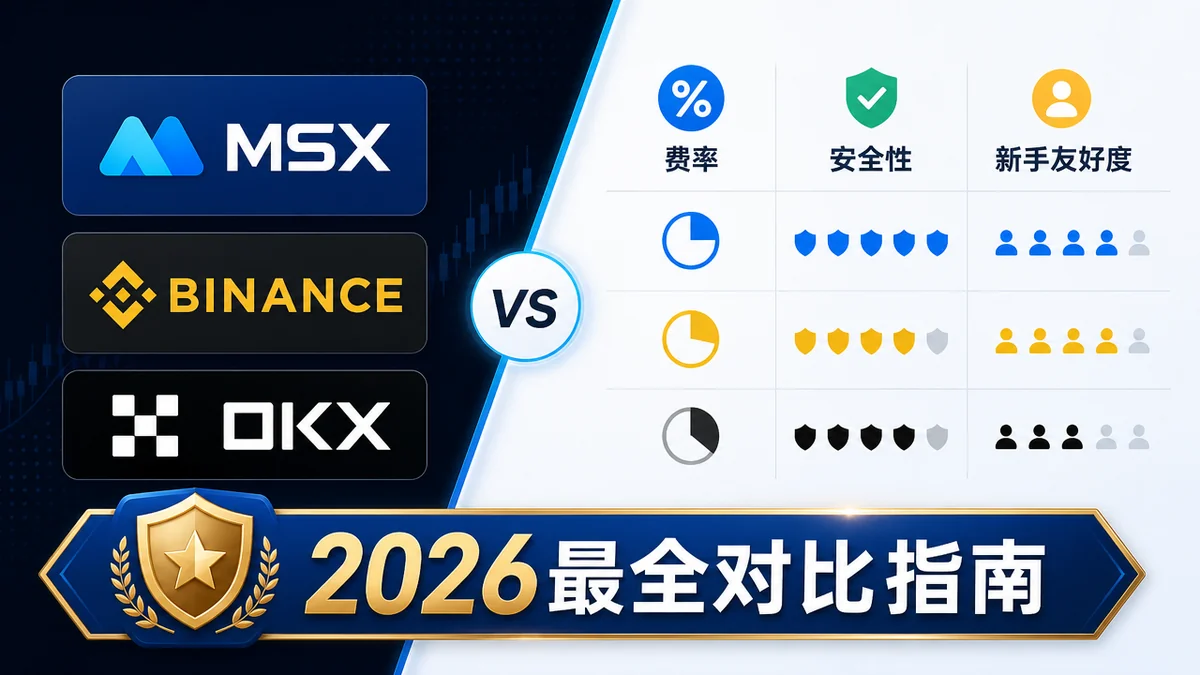
For newcomers to crypto trading, the biggest uncertainty often isn't strategy—it's choosing the right platform. Is it safe? Are fees reasonable? Is it easy to use? This guide compares three leading platforms—MSX, Binance, and OKX—across four dimensions: security, fees, beginner experience, and risk protection.
Platform Fundamentals: Security, Licensing & User Scale
Platform Background & Security Certifications
When selecting a trading platform, start with security basics. MSX uses industry-standard cold wallet storage, keeping critical assets offline while handling daily transactions through hot wallets—ensuring high liquidity without compromising safety. Binance, as one of the world's largest exchanges, has built a multi-layered security system including dynamic multi-signature wallets and real-time risk monitoring. OKX similarly prioritizes fund security with enterprise-grade cold wallet infrastructure.
All three platforms have passed third-party security audits and regularly publish Proof of Reserve statements. For beginners, this means your funds won't vanish into thin air—these platforms maintain public technical transparency.
User Base & Market Position
Binance is the global crypto exchange with the highest trading volume, processing hundreds of billions in daily turnover. Liquidity depth is unmatched, meaning your orders execute quickly with minimal slippage. OKX, as a tier-one exchange, has a substantial user base and sufficient trading depth. While MSX has a relatively smaller user population, it's growing rapidly and gaining recognition especially in emerging Asian markets.
Practical implications for beginners: Major platforms offer excellent liquidity, so small trades won't face order-matching delays. Smaller, specialized platforms often offer better fees and faster product innovation.
Regulatory Licenses & Compliance
Binance holds operating licenses across multiple jurisdictions, including EU MiCA approval. OKX is actively expanding its global compliance framework. MSX, though newer to licensing, has obtained formal operating credentials in major Asian markets.
Important note: Crypto regulation continues evolving, with significant differences across jurisdictions. When choosing a platform, first verify it's permitted in your region.
Trading Fees: Complete Taker/Maker Breakdown & Hidden Costs
Spot Trading Fee Comparison
Fees are the cost beginners care most about. In spot trading, taker (market order) and maker (limit order) fees differ:
| Platform | Maker Fee | Taker Fee | VIP 1 Discount |
|---|---|---|---|
| MSX | 0.01% | 0.02% | 20% |
| Binance | 0.1% | 0.1% | 20% |
| OKX | 0.08% | 0.1% | 15% |
Data as of June 2026
MSX's spot fees are significantly lower than Binance and OKX. On a 10,000 USDT BTC spot purchase as a taker, MSX charges 2 USDT, while Binance and OKX each charge 10 USDT. Over time, this accumulates meaningfully.
Futures Trading Fees & Funding Rates
Futures costs are more complex, including opening/closing fees and funding rates:
| Platform | Futures Maker | Futures Taker | Avg Daily Funding Rate |
|---|---|---|---|
| MSX | 0% | 0.02% | ±0.01% |
| Binance | 0.02% | 0.04% | ±0.015% |
| OKX | 0.02% | 0.05% | ±0.012% |
Data as of June 2026
MSX Contract Trading Fees Explained: 2026 Maker/Taker Rates & Optimization Guide provides detailed fee tier breakdowns. Beginners holding MSX Token receive an additional 25% fee discount, reducing taker rates to 0.015%—among the lowest industry rates.
Hidden Costs: Withdrawal Fees & Deposit Speed
Not all costs appear at trade execution. Withdrawal fees and deposit speed matter equally:
Withdrawal Fees: MSX BTC withdrawal ~0.0005 BTC ($20–30), Binance ~0.0005 BTC, OKX ~0.0004 BTC. Ethereum: MSX ~0.005 ETH, Binance ~0.005 ETH, OKX ~0.002 ETH.
Deposit Channels: All three support bank cards, wire transfers, and third-party payment methods. MSX offers more local fiat channels in Southeast Asia with faster settlement (typically 15 minutes). Binance and OKX have the most comprehensive channels but may experience review queues due to higher user volumes.
Beginner tip: Deposit liquid assets like USDT, withdraw via mainnet to minimize fees, and avoid small-cap tokens with volatile withdrawal rates.
Beginner-Friendliness: Interface, Trading Depth & Liquidity
Trading Interface Complexity & Beginner Mode
MSX launched a simplified trading interface in 2026. Beginner mode displays only essentials: buy/sell buttons, price charts, and positions. This is most beginner-friendly. Binance, while feature-rich, has deeper menu hierarchies requiring adaptation. OKX strikes a middle ground—comprehensive yet intuitive.
If you're trading crypto for the first time, MSX's beginner mode accelerates learning; for experienced traders, all three support advanced interfaces with identical functionality.
Trading Pair Count & Liquidity Depth
Binance offers 1,500+ trading pairs—the most comprehensive. OKX also exceeds 1,000. MSX has fewer pairs (~500) but covers major coins and trending altcoins with sufficient liquidity.
For beginners: BTC, ETH, and major coins have deep liquidity on all three. Binance wins for altcoins; for spot or futures on mainstream coins, all three perform identically.
Supported Deposit/Withdrawal Assets & Channels
All support major currencies (BTC, ETH, USDT). MSX added RWA (real-world asset) trading in 2026, supporting tokenized gold, US stocks, and similar. Binance and OKX lack this feature.
If tokenized traditional assets interest you, MSX has a clear edge; for pure crypto, differences are minimal.
Risk Protection & Account Security Measures
Anti-Fraud & Account Lockdown Systems
Crypto risks extend beyond price volatility—fraud is real. MSX includes phishing detection that identifies fake official links; first-time logins trigger security checks. Binance has the most comprehensive anti-fraud system with anomaly alerts and suspicious transaction freezes. OKX offers similar protection, though slightly less robust.
Must-dos: Enable 2FA (preferably hardware keys like Yubikey, not SMS); keep email and phone current and secure; regularly review login history and change passwords if anomalies appear.
Insurance Funds & Risk Reimbursement
Binance established the largest Security Asset Fund for Users (SAFU), now exceeding $1 billion, covering extreme security incidents. OKX has similar protections. MSX's fund is newer but provides user protection during liquidation events.
Clarify: These funds address platform-level risks (hacking), not user trading losses. If your leveraged position liquidates, funds won't reimburse you.
Liquidation Protection in Leveraged Trading
All three offer leverage, but beginners should avoid it. 10x leverage means a 10% price move wipes your capital. MSX strengthened protection in 2026: the system auto-liquidates 50% of positions before total loss, giving you adjustment time. Binance and OKX trigger immediate full liquidation. Beginner advice: skip leverage unless you fully understand risks and have adequate reserves.
Perpetual Futures vs Spot Trading 2026: Complete Guide to Fees, Leverage Risks & Profit Potential details liquidation mechanics.
Beginner Selection Guide: Platform Recommendations by Need
For Lowest Fees
Choose MSX. Spot taker at 0.02%, futures taker at 0.02%, dropping to 0.015% with 25% MSX Token discount—industry-leading. Active traders save hundreds to thousands monthly.
Too Expensive? 2026 Low-Fee Exchange Alternatives Compared details long-term cost differentials.
For Best Beginner Experience
MSX first, Binance second. MSX's simplified interface and Chinese documentation suit new traders best; beginner mode guidance is clear. Binance, despite complexity, has the richest tutorials and community—easy to find help. OKX falls between them.
For Maximum Fund Safety
Binance first. SAFU fund is largest, track record longest, credibility strongest. All three meet baseline security; the gap here is minimal. Choose based on other factors.
Quick Start: 3-Step Registration & First Trade
Step 1: Registration & Identity Verification
MSX: Visit the website, click "Register," enter email and password. After email verification, upload ID for KYC (usually completed in 10 minutes). Advanced features (futures, leverage) require additional verification—upload bank card or utility bill (1–2 hours).
Binance: Similar process; KYC typically takes 15–30 minutes. High user volume may cause queues, but rarely exceeds 1 hour.
OKX: Fastest KYC, usually 5–10 minutes, though may request additional documents.
Tip: Use a primary email, ensure ID photos are clear, and avoid resubmission delays.
Step 2: Security Setup & Fund Transfer
After registration, immediately:
- Enable 2FA: Use Google Authenticator or Microsoft Authenticator (avoid SMS—vulnerable to SIM swaps)
- Set Withdrawal Whitelist: Only allow pre-registered wallet addresses; reject unknown ones
- Deposit Funds: Transfer USDT or stablecoins via bank card or payment apps (5–30 minute settlement on all three)
Deposit Speed: MSX typically fastest (15 minutes), Binance and OKX 30 minutes–1 hour depending on channel.
Step 3: Your First Trade—Complete Walkthrough
Example: Buying BTC with 1,000 USDT:
- Select Trading Pair: Spot section, choose BTC/USDT
- Pick Order Type:
- Market Order: Executes instantly at market price; higher fee (taker rate). Ideal for quick entry.
- Limit Order: You set price and wait; lower fee (maker rate). May not fill.
- Enter Amount: E.g., 0.025 BTC (~1,000 USDT at current rate)
- Confirm & Execute: Review estimated fee (~0.2 USDT for market order), confirm, trade executes
- Assets Settle: 0.025 BTC appears immediately in Spot Account; sell or transfer anytime
Common Beginner Mistakes:
- Investing entire capital at once: Start with $100 USDT to test flow, scale up when comfortable
- Setting limit orders far from market price: If BTC is $40k, don't bid $30k—it won't fill
- Forgetting 2FA before depositing large amounts: Invites hackers
UI Differences: Binance has the most professional charting; OKX shows order book depth best; MSX displays slippage estimates most clearly. Minor details—core trading is identical.
Summary: Which Platform Suits You?
| Priority | MSX | Binance | OKX |
|---|---|---|---|
| Lowest Fees | ⭐⭐⭐⭐⭐ | ⭐⭐⭐ | ⭐⭐⭐ |
| Beginner-Friendly | ⭐⭐⭐⭐⭐ | ⭐⭐⭐⭐ | ⭐⭐⭐⭐ |
| Pair Selection | ⭐⭐⭐⭐ | ⭐⭐⭐⭐⭐ | ⭐⭐⭐⭐⭐ |
| Fund Safety | ⭐⭐⭐⭐ | ⭐⭐⭐⭐⭐ | ⭐⭐⭐⭐ |
| Customer Support | ⭐⭐⭐⭐ | ⭐⭐⭐⭐ | ⭐⭐⭐ |
Final Recommendation: Fee-conscious or Asian traders? Choose MSX. Want maximum trading pairs and brand confidence? Binance. OKX is a balanced alternative without standout advantages. Best beginner strategy: Start with 100 USDT on MSX to master the workflow, then scale.
FAQ
Which platform—MSX, Binance, or OKX—is safest? ▼
All three have solid security foundations. Binance's SAFU insurance fund is largest (>$1 billion) with the longest track record. MSX and OKX both pass third-party audits and use cold wallets. For beginners, safety differences are minimal. Your own actions matter more: enable 2FA, set withdrawal whitelists—these protect you more than platform choice.
Which platform should beginners choose? ▼
MSX first. The 2026 simplified beginner interface is easiest to learn, fees are lowest, and the community is welcoming to newcomers. Binance is the safe bet—most educational resources and easy problem-solving. Ideally, open accounts on both, practice, then stick with what feels comfortable.
What are withdrawal fees on each platform? ▼
BTC withdrawal: MSX and Binance ~0.0005 BTC, OKX ~0.0004 BTC. Ethereum: MSX and Binance ~0.005 ETH, OKX ~0.002 ETH. Use mainnet withdrawals to avoid unnecessary network fees. Always check current rates before withdrawing—they adjust with network congestion.
If I buy and hold long-term, which platform is most cost-effective? ▼
For buy-and-hold, fee differences barely matter if you don't trade frequently. Focus instead on cheapest deposit channels. MSX has more local fiat options in Southeast Asia with 15-minute settlement. Binance has more comprehensive Western options. Deposit once, hold, platform choice is secondary.
How much fee discount does MSX Token provide? ▼
MSX Token holders receive up to 25% fee discounts on spot and futures. Example: futures taker drops from 0.02% to 0.015%, spot from 0.02% to 0.015%. Discounts scale with token holdings across VIP tiers. For active traders, holding MSX Token pays for itself quickly.
Is leverage trading safe for beginners? ▼
Strongly discouraged. 10x leverage means 10% price movement liquidates you entirely. Even MSX's protection (auto-liquidating 50% of position) can't fully save you. Binance and OKX liquidate immediately. Beginners: accumulate spot experience for 2–3 years before attempting leverage. Protect your capital first.